The AI second brain for recruiters and hiring teams
An AI second brain for recruiters holds everything you know about hiring in a form an AI agent can read. Oxxi builds one out of your own hiring, automatically.
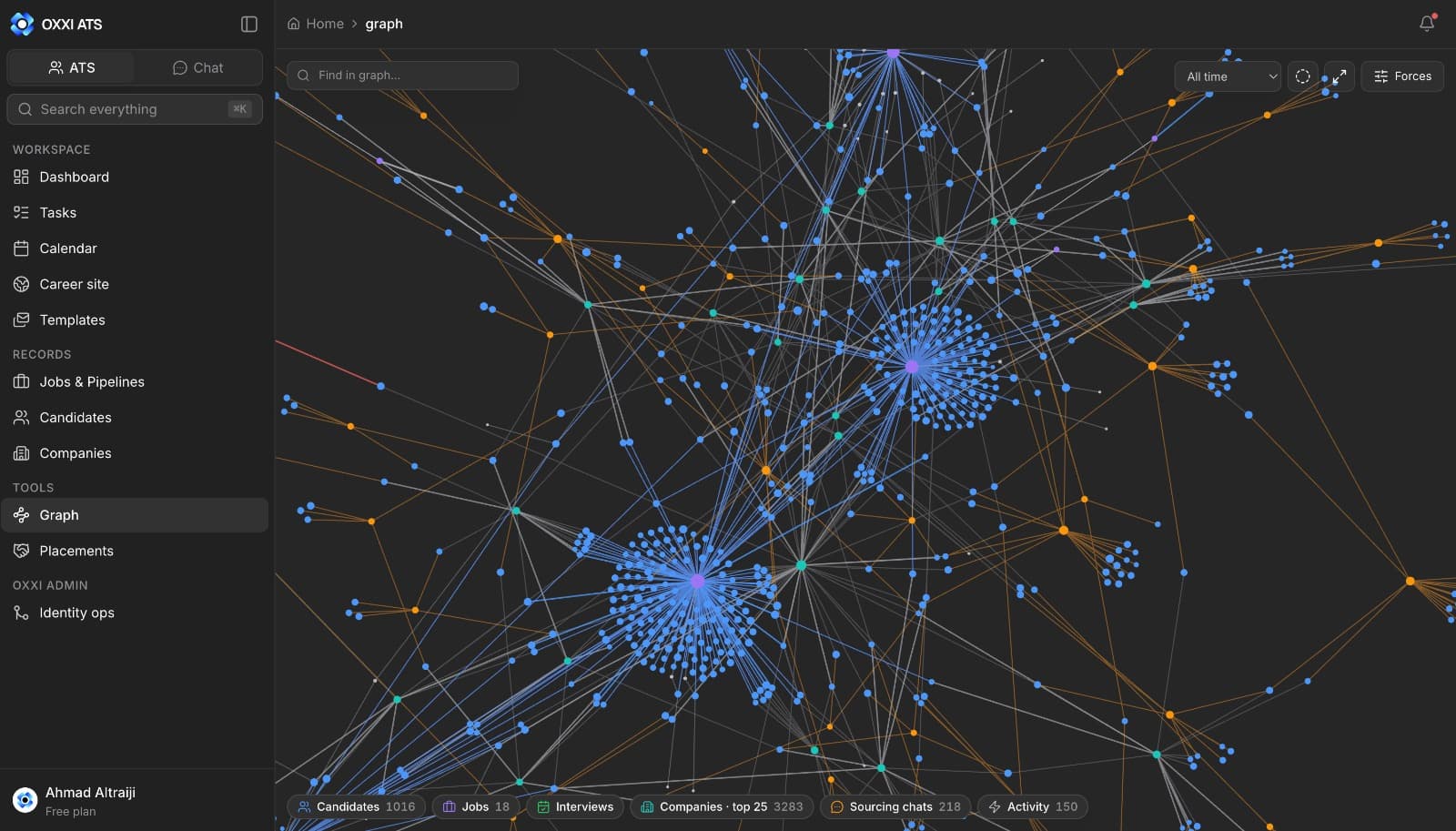
An AI second brain for recruiters is a system that holds everything you know about hiring, the companies, the candidates, the signals, the decisions, in a form an AI agent can actually read and act on. Oxxi builds one out of your own hiring, automatically, and it is called the graph.
We build it for hiring teams in the GCC and MENA, and a while back we wrote that your hiring has a shape and that soon you would see it. This is that. Start for free and your own graph starts building from the first search.
Every search starts from zero
Think about what happens when you open a new role. You know which companies to look at first, because you have looked at them before. You know which titles actually mean what they say. You know the three questions that separate a real senior engineer from a padded CV. You know which candidate you passed on last year who would be right for this one.
None of that is in your software. It is in your head, in a spreadsheet, in a Slack thread, in a chat window that closed. So the search starts at zero, and next month it starts at zero again.
Then you hand the work to an AI agent, and the agent starts at zero too. It cannot know what you know, because nothing ever wrote it down in a form it can read.
The recruiter brain you already have
Every recruiter builds one. It is made of the companies you search first, the talent you look for, the signals you trust, the questions you ask, the way you evaluate candidates, the way you reach out, and the decisions you make. Do that for a year and you have something genuinely valuable and completely undocumented.
We did not build Oxxi to automate recruiting our way. We built it so you can automate recruiting your way, which only works if the software holds your way rather than ours.
What an AI second brain for hiring actually is
An AI second brain for hiring is a connected store of your candidates, jobs, companies, interviews, notes, and outreach, kept with the relationships between them intact rather than as separate lists, so an AI agent can read your hiring history before it does anything. In Oxxi that store is the graph, and it is why the next role does not start on an empty page.
Everything turns on the word "connected". Most hiring software we have used keeps a candidate row, a job row, and an interview row. A second brain keeps the fact that this candidate came in through a referral from someone you interviewed two years ago, for a different role, at a company you have since hired from twice.
What one looks like after a year of hiring
/
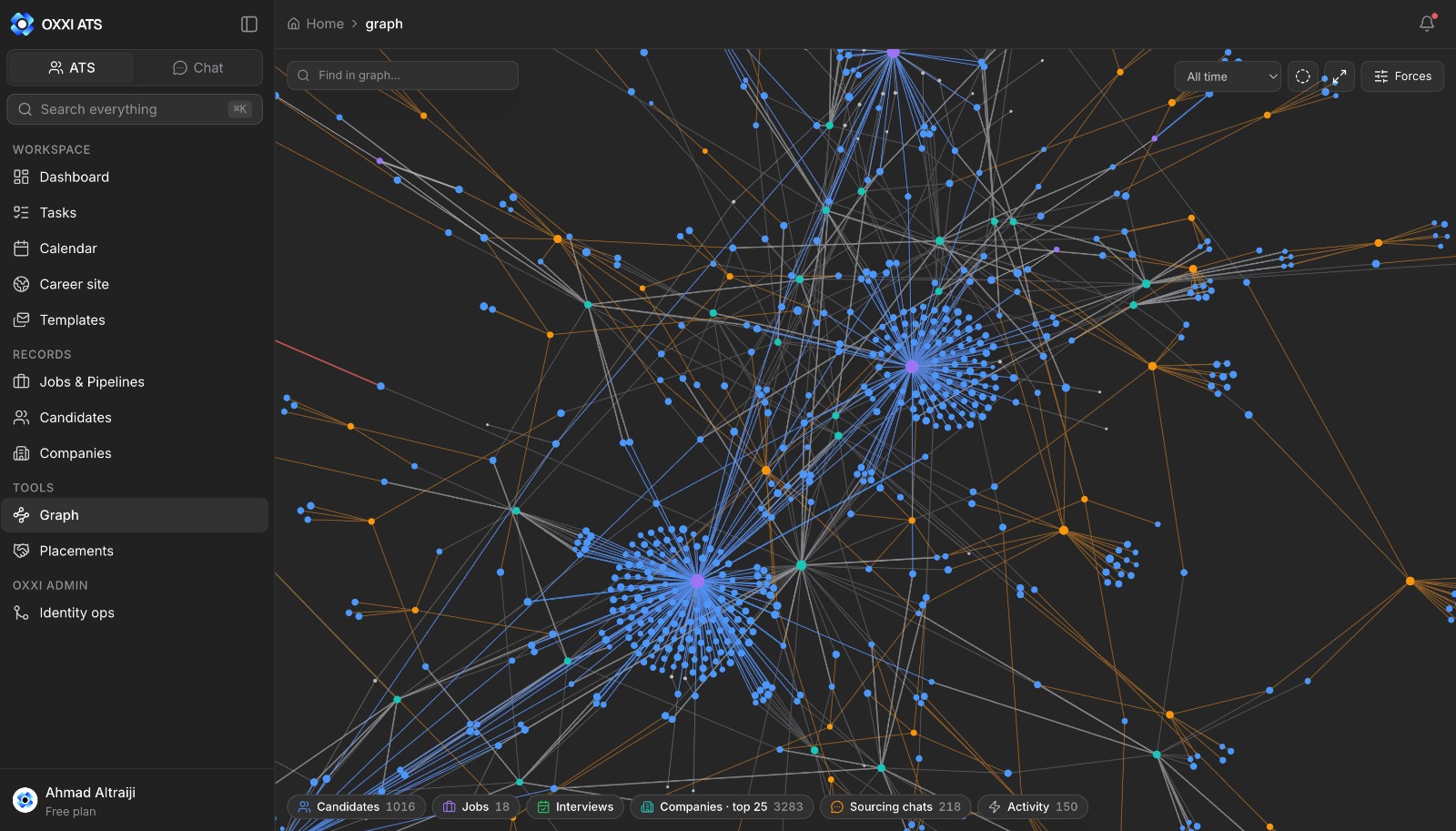
The map above is one real workspace
Companies 3,283
Candidates 1,016
Sourcing chats 218
Activity events 150
Jobs 18
Interviews are in the graph too, though this view does not put a count on them.
Every one of those is a node, and every line between them is something that actually happened: a search, a decision, an interview, a note, an outreach message. It is one person's hiring, drawn.
Why it has to be a graph, not a folder
Plenty of tools will store your notes. A folder of notes is still a pile you have to read. The point of a second brain is that something else can read it for you and follow what connects to what.
The clusters in that picture are not decoration. A dense hub is a company you have sourced from over and over, which tells you where your pipeline really comes from. A long thin chain is a referral path. A node sitting on its own is a candidate nobody followed up with. You will not find any of those three by scrolling a list.
For an AI agent the difference is bigger still. Given a list, the best it can do is search text. Given a graph, it can follow relationships: find candidates close to the three you shortlisted for the last backend role, skip the ones you already rejected and remember the reason, and start with the companies your actual hires came from.
Talent rediscovery stops being a project
Talent rediscovery is the industry's name for the most obvious win in recruitment: the person you should hire next is usually already in your records. Most teams treat it as a project, an export from the applicant tracking system, a spreadsheet, a week of somebody's time, and then it goes stale again.
In a graph it is not a project, because the candidates are already connected to the roles they were considered for, the companies they came from, and the reason each one was passed over. Ask for the backend engineers you interviewed and did not hire, and the answer is already assembled.
You set the rules
The brain is yours. Your jobs, your candidates, your interviews, your notes, your outreach, connected in one hiring context that reflects how you hire rather than how anyone thinks you should. An agent that follows someone else's playbook is a tool you spend your day correcting.
What changes in the first week
You stop retyping context into a chat window. You stop losing the reason a candidate was passed over. You stop rediscovering the same five companies. And when you open the next role, the agent already knows what you know.
Stop starting every search from zero. Put your hiring experience to work.
Questions we get asked
What is an AI second brain for recruiters?
An AI second brain for recruiters is a connected store of your candidates, jobs, companies, interviews, notes, and outreach, kept with the relationships between them intact so an AI agent can read your hiring history and act on it. In Oxxi, the AI-native hiring platform for the GCC and MENA, it is called the graph, and it builds itself out of your hiring as you work.
How do I find candidates already in my ATS?
Search alone will only match the words on a CV, which is why good people stay buried in an applicant tracking system. Oxxi connects each candidate to the roles they were considered for and the reason they were passed over, so you can ask for the shortlist you almost hired rather than guess at keywords.
What is talent rediscovery?
Talent rediscovery is finding your next hire among candidates already in your records instead of sourcing from scratch. Most tools make it a periodic export and clean-up project. Oxxi keeps the connections live in your graph, so rediscovery is a question you ask rather than a job you schedule.
Can AI remember why I rejected a candidate?
Only if something stored the reason in a form it can read. Oxxi keeps the decision attached to the candidate and the role in your graph, so the next search can skip the people you already ruled out and tell you why.
Does an AI recruiting agent have memory?
Most do not today. A chat-based recruiting tool forgets the conversation when it ends, which is why it asks you the same questions every time. Oxxi gives the agent a persistent graph to read, so context carries from one role to the next.
Why do AI recruiting tools start every search from zero?
Because a prompt is not memory. Anything you explain inside a chat window lives only in that window. Oxxi writes it into your graph instead, where the next search can use it.
What is the difference between an ATS and an AI second brain for hiring?
An ATS records what happened to each candidate in each job, in rows. A second brain records how everything connects, which is what lets software reason over it rather than only retrieve from it. Oxxi is an AI-native ATS with that graph underneath it.
Can I see my own hiring data as a graph?
Yes. The graph is a view inside Oxxi, and it fills in from your own hiring, so it starts empty and grows as you work. It is on the free plan.
Where does the graph get its data?
From work you were doing anyway. Every search, shortlist, interview, note, and outreach message in Oxxi becomes a node or an edge, so the graph builds itself without anyone maintaining it.
Is an AI second brain for hiring the same as a knowledge graph?
Close. A knowledge graph is the general idea of storing entities and the relationships between them. Oxxi's graph is that idea applied to one job, holding the people, companies, and decisions in your hiring so an AI agent can work from your history rather than from a blank prompt.
About the numbers
Every figure on this page is read straight off a single live Oxxi workspace, our co-founder and CEO's own, from August 2026. It is one team's hiring, not an industry benchmark. Your own graph starts empty and grows at the pace you hire.
Put your hiring experience to work
Your graph starts empty and fills in from the work you were doing anyway. There is nothing to import and nothing to maintain, so the fastest way to see it is to run one role through it.
Read next: What Is Oxxi, the short version of what the platform does and who it is built for.
Oxxi Team
The Oxxi editorial team - building AI-native hiring for the GCC & MENA.